How to Embed 608/708 Closed Captioning for Broadcast
How do broadcasters embed CTA-608 and CTA-708 captions into a video file?
Caption data is packaged into a caption distribution packet and written into the file's ancillary data track — not into the picture. A caption editor, transcoder, or NLE performs the wrap, and because the data sits in its own track, most tools can insert or replace it without re-encoding the video.
Embedded captioning is the default for US broadcast masters, and the part of a captioning workflow most likely to be handed to someone who has never done it before. The good news is that it is a wrapping operation, not a rendering one — which is why it is fast, lossless, and reversible.
This guide covers what the standards are actually called in 2026, how the data is carried in each container, which tools do the embedding, and why ATSC 3.0 changes the answer entirely.
What Is Embedded Captioning?
Embedded captioning is caption data carried inside the video file or stream as ancillary data, in a track of its own alongside video and audio. The viewer can turn it on and off, because the text is never drawn into the picture.
That distinguishes it from two other things it is often confused with:
- Open captions and burnt-in subtitles are part of the video essence. They cannot be turned off, and correcting them means re-rendering the video.
- Sidecar caption files are separate files — SCC, STL, TTML — delivered next to the video. They can be corrected independently but can also be lost or mismatched in transit.
If you are not sure which one your spec is asking for, our guide to closed captions vs subtitles vs SDH covers the terminology.
CTA-608 vs CTA-708: What They Are and What to Call Them
You will see these standards written as EIA-608, CEA-608, and CTA-608, and all three refer to the same lineage. The specifications moved from the Electronic Industries Alliance to the Consumer Electronics Association and then to the Consumer Technology Association, and the documents were renamed each time.
CTA-608 and CTA-708 are the current names. The current revisions are ANSI/CTA-608-E and ANSI/CTA-708-E. Many delivery specs still say EIA or CEA, which is not an error on their part — just an older document.
| CTA-608 | CTA-708 | |
|---|---|---|
| Designed for | Analogue NTSC, line 21 | ATSC 1.0 digital television |
| Grid | 32 characters × 4 rows | Flexible; positioning anywhere in a defined window |
| Styling | Fixed font, 8 colours, italic and underline | Multiple fonts, sizes, colours, opacity, edge effects |
| Character set | Basic Latin plus a small extended set | Full Unicode support |
| Services | CC1–CC4, plus text services | Up to 63 caption services |
| Status in 2026 | Still carried for compatibility | Primary standard for ATSC 1.0 |
In practice these are not an either/or choice. A typical US digital broadcast carries a 708 service with 608 compatibility bytes tunnelled inside the same caption distribution packet, so legacy decoders still get something readable. When a spec says "608/708", that is what it means.
How Caption Data Is Carried in Each Container
The caption bytes are the same; what changes is the envelope. This is the part that determines whether your file works on the receiving end.
| Container / signal | How captions are carried | Reference |
|---|---|---|
| SDI | Caption distribution packet in the vertical ancillary (VANC) space | SMPTE ST 334 |
| MXF | ANC data track wrapping the VANC packets | SMPTE ST 436 |
| QuickTime MOV | Dedicated closed caption track (c608 / c708) |
QuickTime file format |
| MP4 / H.264 | Caption bytes in SEI user data within the elementary stream | ATSC A/72 |
| Transport stream | Picture user data in the video elementary stream | ATSC A/53 |
| ATSC 3.0 | Separate IMSC track — not 608/708 at all | ATSC A/343 |
Two practical consequences follow from this table. First, a file that "has captions" in one container may lose them entirely when rewrapped by a tool that does not understand the target's ancillary structure. Second, MP4 is the format where captions most often go missing, because the data is inside the video elementary stream rather than in a track a container inspector will show you.
How to Embed EIA-608 and EIA-708 Closed Captioning
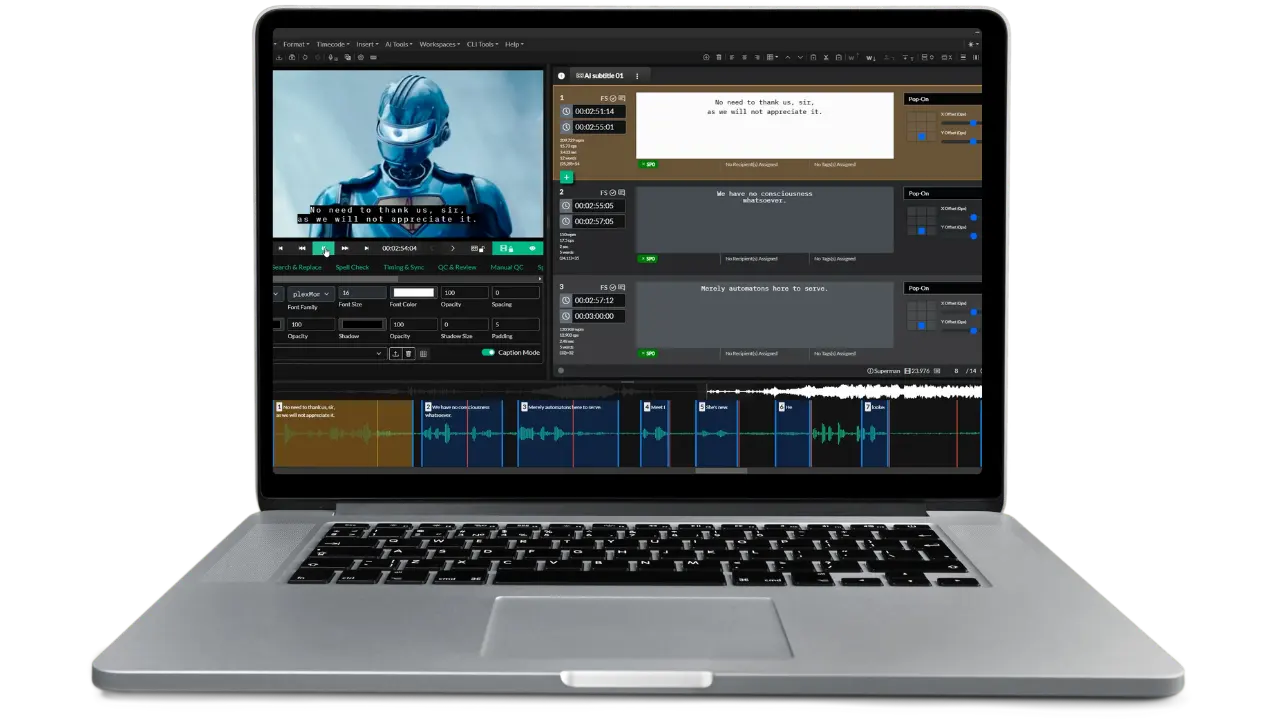
The sequence is the same regardless of which tool you use.
- Author and QC the captions first. Embedding is a wrap, not an edit — fixing a typo after embedding means unwrapping, correcting, and rewrapping. Run your QC pass before this step, not after.
- Confirm the frame rate and drop frame setting of the video, and make sure the caption timings match exactly. A 29.97 non-drop caption file against a 29.97 drop frame master drifts by roughly 3.6 seconds per hour.
- Choose 608, 708, or both according to the delivery spec. When in doubt for US broadcast, both.
- Embed into the target container using a caption editor, transcoder, or NLE.
- Verify by extracting. Pull the captions back out of the finished file and compare against the source. This is the only check that proves the ancillary track survived the wrap.
Tool Options Compared
| Approach | Examples | Containers | Best for |
|---|---|---|---|
| Caption editor with embed plugin | Closed Caption Creator | MXF, MP4, MOV | Editing, embedding, and extracting in one place |
| Video transcoder | Telestream Vantage, Drastic NET-X-CODE | Broad | High-volume automated plant workflows |
| Cloud transcoder | AWS Elemental, Google Cloud Video Transcoder | Broad | Burst volume, consumption pricing, no plant hardware |
| NLE | Premiere Pro, Media Encoder | MXF well; MOV 608 only; no MP4 | Finishing a master you are already exporting |
The NLE row is the one that surprises people. Premiere Pro handles MXF embedding properly, supports only 608 on MOV export, and does not embed captions into MP4 at all. If your spec calls for captioned MP4, the export has to happen somewhere else.
Closed Caption Creator's embed and extract plugin writes 608 and 708 into MXF, MP4, and MOV without re-encoding, and extracts captions back out of existing files for editing — useful when the only copy of the captions is inside a delivered master.
ATSC 3.0 Does Not Use 608 or 708
This is the biggest change to this topic since the standard was written, and it catches teams out.
ATSC 3.0 (NextGen TV) specifies IMSC 1.0.1 for captions and subtitles, in text profile (im1t), image profile (im1i), or both. The governing document is ATSC A/343, most recently revised in April 2026. Captions are carried as a separate timed-text track over ROUTE-DASH or MMT rather than as ancillary data in the video.
For stations simulcasting ATSC 1.0 and 3.0, this means producing captions in both forms: 608/708 ancillary data for the 1.0 path, IMSC for the 3.0 path. Authoring once and converting is usually the practical answer — our TTML and IMSC explainer covers what the format can carry, and caption converters covers the conversion step.
Embedded vs Sidecar: Which to Deliver
| Embedded | Sidecar | |
|---|---|---|
| Files to manage | One | Video plus one file per language |
| Correcting a typo | Unwrap, edit, rewrap | Edit the caption file only |
| Multi-language | Limited by the standard's service count | Add a file per language |
| Risk in transit | Cannot be separated from the video | Can be lost or mismatched |
| Typical use | Linear broadcast masters | Streaming, localisation, archive |
Follow the delivery spec, which will almost always name one. Common sidecar formats for broadcast are SCC, EBU-STL, and TTML; our format support page lists what each one can carry.
When Embedded Captions Do Not Appear
Three causes account for most cases.
The player does not read ancillary data
Many consumer and web players read sidecar files only. A file can be perfectly captioned and still show nothing in VLC or a browser. Verify with a tool that inspects the ancillary track directly, or by extracting the captions back out, before concluding the embed failed.
Frame rate mismatch
Caption timings encoded against one frame rate and video running at another produce progressive drift — correct at the top of the programme, seconds out by the end. Confirm both the rate and the drop frame flag before embedding.
608 written where 708 is expected
A decoder looking for a 708 service will find nothing if only 608 was written, and vice versa. For US broadcast the safe default is to write both.
If none of these explains it, the caption data may have been stripped during an intermediate rewrap. Test by extracting captions from each file in the chain to find the step where they disappear.
Frequently Asked Questions
What is the difference between 608 and 708 captions?
CTA-608 is the older line 21 standard, limited to 32 characters across four rows with a fixed character set and minimal styling. CTA-708 is the digital television standard and supports multiple fonts, sizes, colours, opacity, and free positioning. In practice most US digital broadcasts carry both: 708 as the primary service with 608 compatibility bytes tunnelled inside it.
Are they called EIA-608 or CTA-608?
CTA-608 and CTA-708 are the current names. The standards moved from the Electronic Industries Alliance to the Consumer Electronics Association and then to the Consumer Technology Association, so the same documents have been published as EIA, CEA, and now CTA. The current revisions are ANSI/CTA-608-E and ANSI/CTA-708-E; older delivery specs often still say EIA or CEA.
How are closed captions stored inside an MXF file?
As ancillary data. Caption bytes are packaged into a caption distribution packet, carried in the vertical ancillary space per SMPTE ST 334, and wrapped into the MXF file as an ANC data track per SMPTE ST 436. The captions sit in their own track alongside video and audio rather than being part of the picture.
Can you embed captions without re-encoding the video?
In most cases yes. Because caption data lives in a separate ancillary track rather than in the picture, a tool that rewraps the container can insert or replace it without touching the video essence. That keeps the operation fast and lossless. Re-encoding is only unavoidable when the container or codec has to change as well.
Does ATSC 3.0 use 608 or 708 captions?
Neither. ATSC 3.0 specifies IMSC 1.0.1 for captions and subtitles, in text profile, image profile, or both, per ATSC A/343. CTA-708 remains the standard for ATSC 1.0 broadcasts, so stations simulcasting both currently produce captions in both forms.
Should I deliver embedded captions or a sidecar file?
Follow the delivery spec, which almost always names one. Embedded suits linear broadcast masters because one file carries everything and cannot be separated in transit. Sidecar files suit multi-language and streaming workflows because captions can be corrected or added without touching the video at all.
Why do my embedded captions not appear on playback?
The three usual causes are a player that reads sidecar files but not ancillary data, a frame rate mismatch between the caption data and the video track, and captions written as 608 only into a container the decoder reads as 708 or vice versa. Verify with a tool that inspects the ancillary track directly rather than trusting a consumer player.
Need to embed or extract 608/708 captions? See the embed and extract plugin or start a free trial.