The Best Closed Caption & Subtitle Editors for Broadcast in 2026
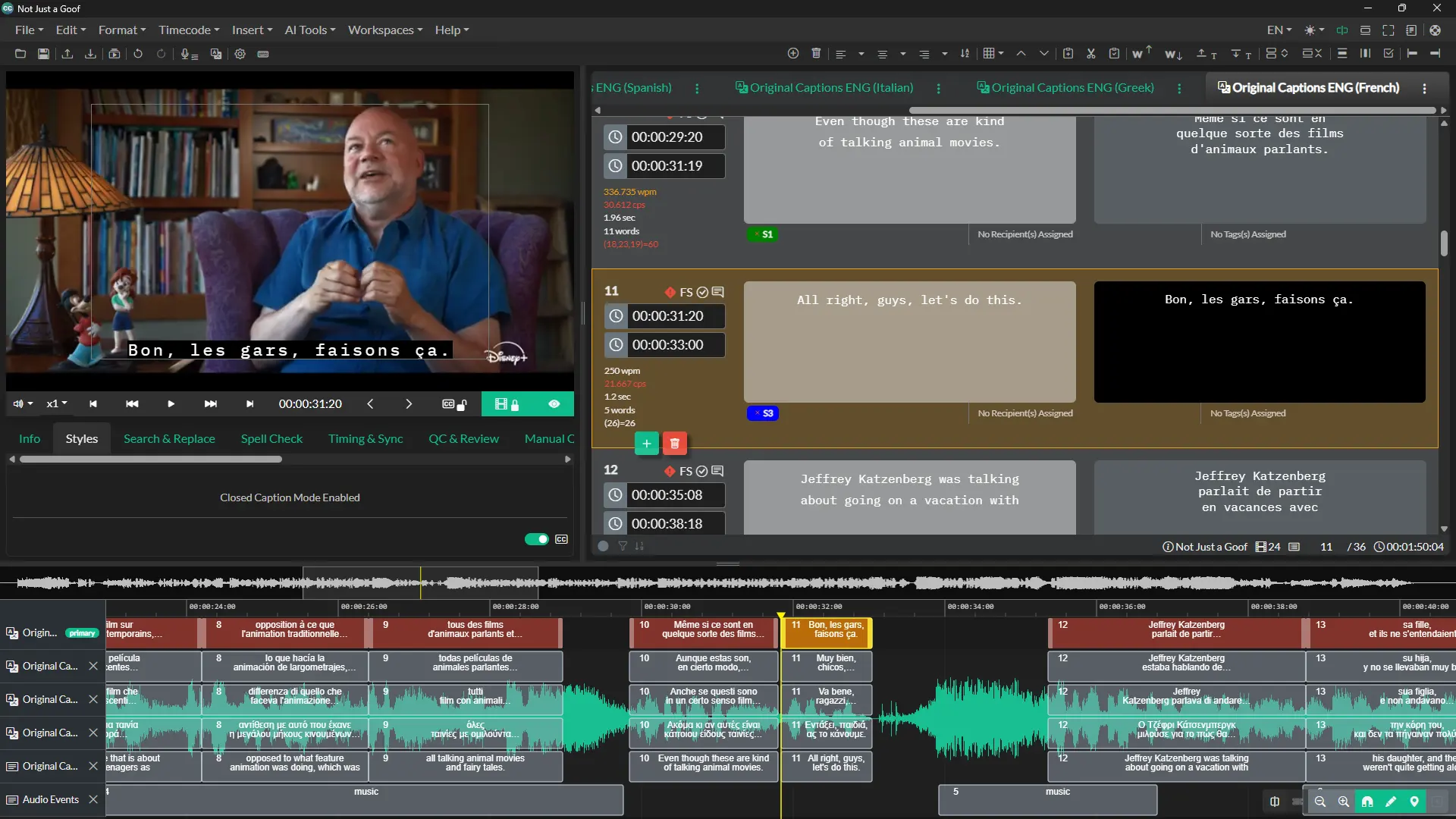
Which caption editor should a broadcast team actually buy?
Pick a frame accurate editor that writes your delivery format natively and produces a QC report — those three requirements eliminate most tools immediately. Closed Caption Creator, Ooona, and EZTitles all clear that bar; the deciding factors are usually platform, licensing model, and whether your team needs browser-based collaboration.
The caption editor market changed more between 2023 and 2026 than it had in the decade before. Telestream retired MacCaption, the Mac facilities that ran on it had to move, browser-based tools stopped being a novelty, and free Whisper transcription arrived in almost every product on this list.
What has not changed is the failure mode. Teams choose an editor on transcription quality and then discover, three deliveries in, that it cannot write SCC at 29.97 drop frame without drift, or cannot produce the QC report the broadcaster asks for.
Here is how seven current options compare, and where each one stops being appropriate.
Broadcast Caption Editors at a Glance
| Editor | Platforms | Frame accurate | QC / style guide | Licensing | Best for |
|---|---|---|---|---|---|
| Closed Caption Creator | Windows, macOS, Linux, browser | Yes | Yes — custom style guides, QC reports | Subscription | Multi-seat teams and mixed-platform facilities |
| Ooona | Browser (any OS) | Yes | Yes — QC module | Subscription, modular | Localisation vendors running high subtitle volume |
| EZTitles | Windows | Yes | Yes | Perpetual or subscription | Windows facilities that want to own the licence |
| Telestream Stanza | Windows, macOS, Linux | Yes | Yes | Subscription | Existing Telestream shops staying in-ecosystem |
| CaptionMaker | Windows | Yes | Partial | Perpetual + support | Legacy MacCaption projects and licence keys |
| Subtitle Edit | Windows | No | No | Free, open source | Prep work, format conversion, learning |
| Premiere Pro / Resolve | Windows, macOS | Timeline only | No | Subscription / perpetual | Burn-in and embedding, not authoring |
Disclosure: Closed Caption Creator is our own product. We have tried to describe where it is and is not the right choice.
What Makes an Editor Broadcast Ready
Consumer subtitle tools and broadcast caption editors look similar in a screenshot. Four things separate them.
Frame accurate timing
Broadcast specs are written in timecode, and SCC encodes caption data against a specific frame rate and drop frame setting. An editor that stores timings as floating point seconds will round on export. On a 90-minute programme delivered at 29.97 drop frame, that rounding is the difference between a clean QC pass and captions that sit a frame late for the whole third act.
Native delivery formats
Exporting SRT and letting someone else convert is not a workflow. If your spec calls for SCC, MCC, EBU-STL, or IMSC/TTML, the editor should write it directly, with positioning and styling intact. Our format support page lists what each format can and cannot carry.
Style guide validation
Netflix, the BBC, and most broadcasters publish a style guide with hard limits on reading rate, line length, minimum duration, and gap. A professional editor holds those as a profile and flags violations while you work, rather than after the file has been rejected. See our reading speed guide for the numbers most specs use.
A QC report you can hand over
Many delivery specs now require evidence, not just a clean file. If the editor cannot produce a report, someone on your team is producing it by hand. Our QC and review feature covers what a useful report contains, and the QC checklist covers what to look for.
The Editors
Closed Caption Creator
https://www.closedcaptioncreator.com/
A frame accurate caption and subtitle editor that runs natively on Windows, macOS, and Linux, and in the browser. It supports more than 30 caption and subtitle formats, imports video locally without uploading it, and covers captions, subtitles, transcripts, and audio description in a single application.
Key features:
- Custom style guide profiles with live validation and exportable QC reports
- Automatic transcription and machine translation built in
- Plugins for embedding 608/708 captions and generating audio description
- Local video import — pre-release media never leaves the machine
- Team licensing priced for multi-seat facilities rather than per enterprise seat
Use it when you need one tool across a mixed Windows/Mac/Linux team, or when per-seat cost is what is blocking you from equipping everyone properly.
Ooona
A modular, browser-based toolkit built for media localisation. Ooona covers creation, translation, review, and conversion across more than 60 timed-text formats, with frame accurate timing, waveform scrubbing, and shot change detection. It is a Netflix-recognised subtitling tool, which matters if you deliver to their originals pipeline.
Key features:
- Runs entirely in the browser — nothing to install, any OS
- Modular licensing: buy only the Create, Translate, Review, or Convert modules you use
- Shot change detection and audio scrubbing for frame accurate spotting
- Management layer for vendors coordinating freelance linguists
Use it when you are a localisation vendor running high subtitle volume across many languages and freelancers, and want the management layer as much as the editor.
EZTitles
https://www.eztitles.com/eztitles-subtitling-software
A long-established Windows subtitling application with deep format coverage, including container formats like MXF and MPEG. It handles complex scripts well, including Japanese vertical subtitles, and remains one of the few professional editors still offered on a perpetual licence.
Key features:
- Perpetual licence option — you own the version you buy
- Broad broadcast and DVD/Blu-ray authoring format support
- Strong CJK and vertical subtitle handling
- Windows only, and priced at the professional end
Use it when you are an all-Windows facility, capital expenditure is easier than subscription, and you need the deepest format coverage available on one desktop.
See a detailed side-by-side comparison: Closed Caption Creator vs. EZTitles.
Telestream Stanza
https://www.telestream.com/captions/
Telestream's current-generation caption editor, launched in 2022 as a subscription product for Windows, macOS, and Linux. It is a ground-up rebuild rather than a continuation of MacCaption, so the interface and workflow are new even to long-time Telestream users. It fits North American broadcast workflows well, particularly where Vantage is already in the plant.
Key features:
- Cross-platform: Windows, macOS, and Linux
- Fits alongside Vantage and the rest of the Telestream stack
- Subscription only — no perpetual option
- Per-seat cost is high enough to limit freelance and large multi-seat adoption
Use it when your facility already runs Telestream transcoding and keeping the captioning step in the same ecosystem is worth the licence cost.
CaptionMaker
https://www.telestream.net/captioning/
The Windows sibling of the retired MacCaption, and still supported. Telestream ended MacCaption support on 1 May 2023 — version 8.1.1, released in January 2023, was the last build — and pointed customers here or to Stanza. CaptionMaker accepts MacCaption licence keys and opens MacCaption project files, which makes it the shortest migration path for an archive of legacy projects.
Key features:
- Opens MacCaption projects and accepts MacCaption licence keys
- Mature 608/708 authoring and embedding for US broadcast
- Windows only — no help to the Mac facilities MacCaption's retirement displaced
- Interface shows its age, and collaboration features are minimal
Use it when you have a MacCaption project archive to keep readable and a Windows machine to read it on. For new work, the newer tools on this list are better places to start.
See a detailed side-by-side comparison: Closed Caption Creator vs. CaptionMaker (MacCaption).
Subtitle Edit
https://www.nikse.dk/subtitleedit
The best free subtitle tool there is, and genuinely useful — the 4.x releases read and write over 300 formats and include local Whisper transcription at no cost. It is also not a broadcast delivery tool. Timings are not frame accurate in the sense a 29.97 drop frame SCC delivery requires, and there is no style guide validation or QC reporting.
Key features:
- Free and open source (GPL v3), Windows
- 300+ format read/write — excellent as a conversion utility
- Built-in Whisper transcription, OCR, waveform sync, spell check
- No frame accurate timing model, no QC report, no style guide profiles
Use it when you are prepping, converting, or learning. Most facilities keep it installed next to a professional editor rather than in place of one.
See a detailed side-by-side comparison: Closed Caption Creator vs. Subtitle Edit.
Premiere Pro and DaVinci Resolve
https://www.adobe.com/products/premiere.html
Both NLEs now include free automatic transcription and caption tracks, and both can burn in captions or embed them on export. They are good at the finishing end of the workflow and weak at the authoring end: no style guide validation, no QC report, and a narrow set of sidecar export formats.
Key features:
- Automatic transcription included in the subscription or licence
- Full control over burn-in styling and positioning
- Useful for embedding a finished caption file into a master
- No QC reporting, no style guide profiles, limited sidecar formats
Use it when the captions are already written and QC'd and you just need them in the master. If you are weighing tooling more broadly, our build vs. buy analysis covers the same trade-off for engineering teams.
Which One to Pick
Work backwards from the delivery spec rather than forwards from the feature list.
- Mixed-platform team, cost per seat matters: Closed Caption Creator.
- High-volume localisation vendor, many languages and freelancers: Ooona.
- All-Windows facility that wants to own the licence: EZTitles.
- Already a Telestream plant: Stanza.
- Legacy MacCaption archive to keep readable: CaptionMaker.
- No budget, prep work only: Subtitle Edit.
- Captions already finished, just need embedding: your NLE.
Whatever you choose, test it against a real delivery before you commit. Author a short segment, export it in your actual spec format at your actual frame rate, and run it through the broadcaster's QC. Editors that look identical in a demo diverge sharply at that step.
Frequently Asked Questions
What is the best closed caption editor for broadcast?
For most broadcast teams, Closed Caption Creator, Ooona, and EZTitles are the strongest options because all three are frame accurate and write the broadcast sidecar formats directly. Closed Caption Creator runs on Windows, macOS, Linux, and the browser and is generally the best value for multi-seat teams; EZTitles suits Windows-only facilities that want a perpetual licence.
Is there a free closed caption editor good enough for broadcast?
Subtitle Edit is free, open source, and reads and writes over 300 formats, which makes it viable for prep work and format conversion. It is not frame accurate in the way broadcast delivery expects, and it has no style guide validation or QC reporting, so most facilities use it alongside a professional editor rather than instead of one.
What replaced MacCaption after Telestream retired it?
Telestream ended MacCaption support on 1 May 2023, with version 8.1.1 as the final release. Telestream directs customers to CaptionMaker, which is Windows only but accepts MacCaption licence keys and opens MacCaption projects, or to Stanza, a subscription editor that runs on Windows, macOS, and Linux but is a ground-up rebuild rather than a continuation.
Can I use Premiere Pro or DaVinci Resolve for broadcast captions?
For finishing and burn-in, yes. For caption authoring and delivery, they are limited: neither produces a QC report, neither validates against a broadcaster style guide, and their sidecar exports cover only a handful of formats. NLEs work well for embedding a finished caption file into a master, and poorly as the place the captions are written.
Does a broadcast caption editor need to be frame accurate?
Yes. Broadcast specs are written in timecode, not seconds, and formats like SCC encode caption data against a specific frame rate and drop frame setting. An editor that works in floating point seconds will round timings on export, which shows up as drift and as failed QC on a 29.97 drop frame delivery.
Which caption editors run on macOS?
Closed Caption Creator, Ooona, and Telestream Stanza all run on macOS, and Ooona and Closed Caption Creator also run in the browser on any platform. EZTitles, CaptionMaker, and Subtitle Edit are Windows only, which has been the main reason Mac facilities changed tools since MacCaption was retired.
What caption formats does a US broadcaster usually ask for?
SCC or MCC for traditional ATSC 1.0 delivery, and IMSC for ATSC 3.0. Streaming platforms generally want IMSC or TTML, and European broadcasters want EBU-STL. Our guide to FCC closed captioning requirements covers what the rules require beyond the file format itself.
Evaluating editors for a team? Start a free trial or talk to us about multi-seat licensing.