Audio Description Requirements: The 2026 Compliance Guide
Is audio description required by law?
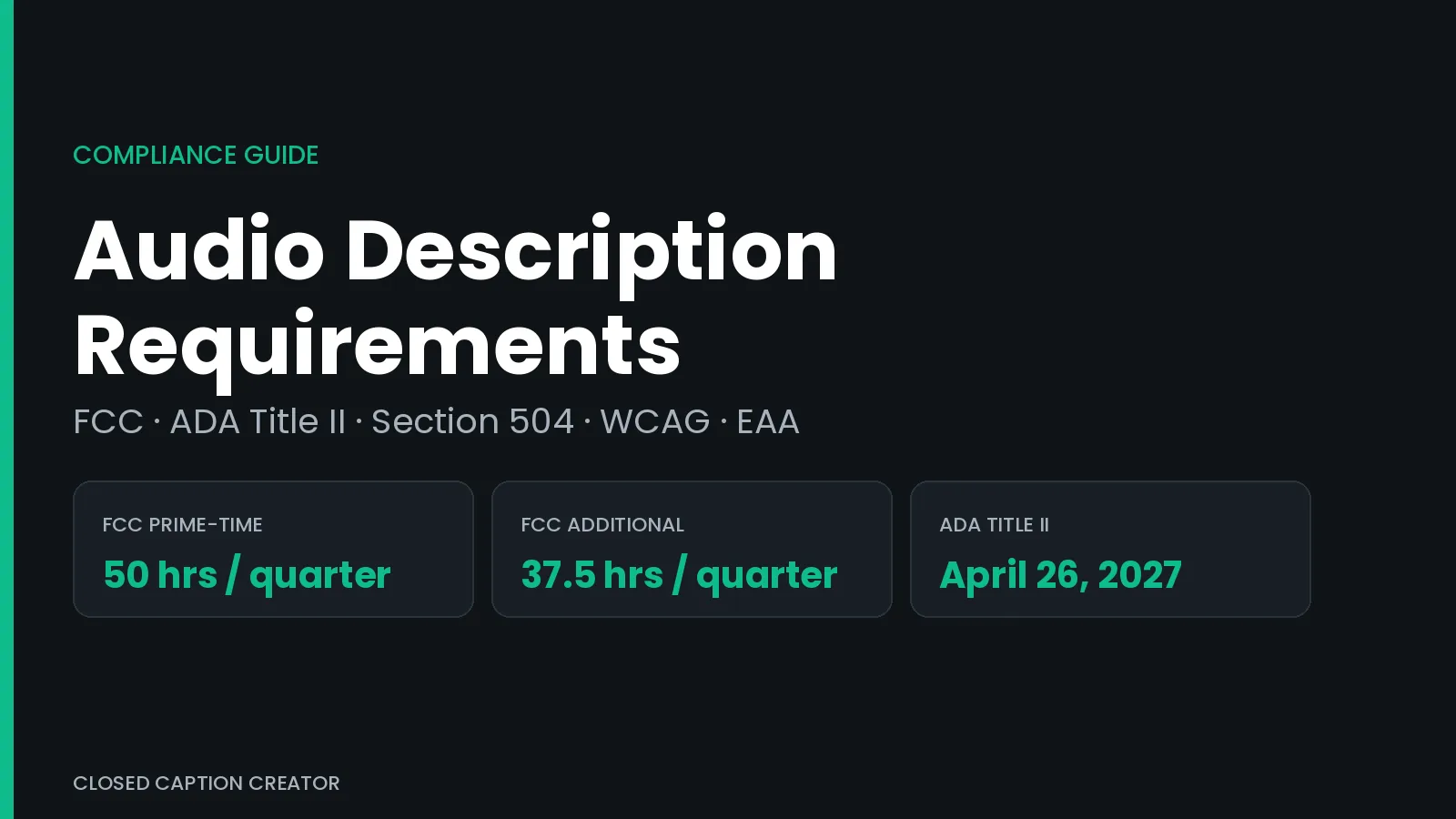
Audio description is required by three separate systems of law. The FCC sets hour quotas for US broadcasters and large cable operators under 47 CFR 79.3. The ADA, Section 504, and Section 508 require it for covered digital video through WCAG. In the EU, member states set their own targets under AVMSD Article 7.
Who Has to Provide Audio Description?
Audio description is a spoken narration track that describes the important visual action in a video. It plays in the natural gaps between dialogue so a blind or low-vision viewer can follow the story.
Most caption teams know their captioning obligations well. Audio description obligations are less familiar, partly because they come from a different set of rules, and partly because they phase in gradually rather than all at once.
The first question is not "how much description do I need." It is "which rulebook covers my content." Broadcast television, government websites, health care portals, and EU streaming services are each governed by a different authority.
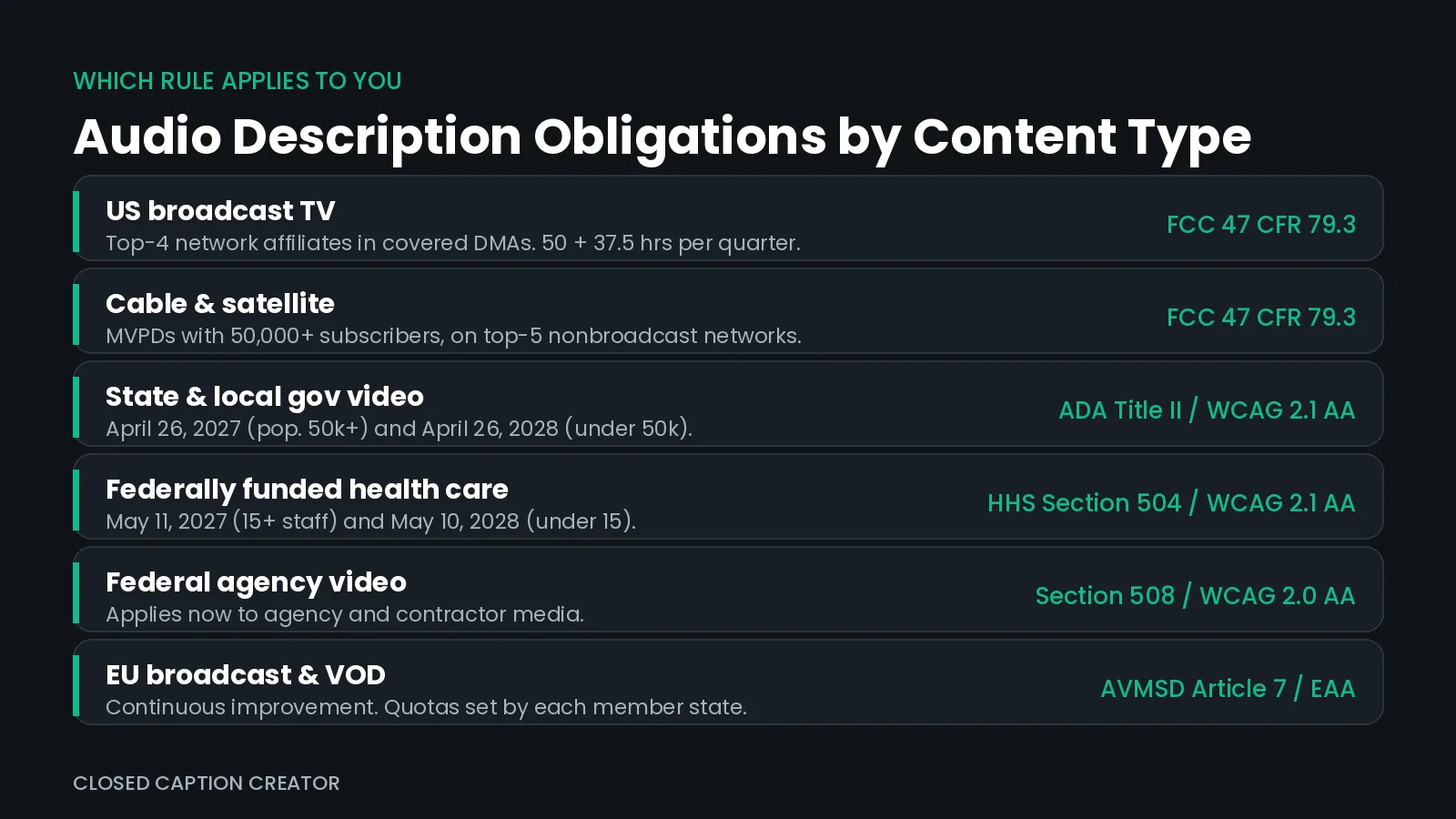
If your content airs on US television, start with the FCC. If it lives on a website, an app, or a learning platform, start with WCAG. Many media companies have to satisfy both.
What Does the FCC Require for Audio Description?
The FCC regulates audio description under 47 CFR § 79.3. The rule comes from the Twenty-First Century Communications and Video Accessibility Act (CVAA), the same law behind many of the FCC closed captioning requirements.
The rule sets quarterly hour quotas rather than a blanket "describe everything" mandate. Two numbers matter.
| Requirement | Amount per calendar quarter | When it must air |
|---|---|---|
| Primary quota | 50 hours | Prime time or children's programming |
| Additional quota | 37.5 hours | Between 6:00 a.m. and 11:59 p.m. local time |
That is 87.5 described hours per quarter in total for a covered station or system.
Which broadcasters are covered?
The quotas apply to commercial television stations affiliated with one of the top four broadcast networks: ABC, CBS, Fox, and NBC. The station also has to sit in a Nielsen Designated Market Area (DMA) that the phase-in has already reached.
Which cable and satellite systems are covered?
Multichannel video programming distributors (MVPDs) with 50,000 or more subscribers must meet the same 50 and 37.5 hour quotas. The obligation applies on each channel carrying one of the top five national nonbroadcast networks.
The FCC ranks those top five networks and publishes the list on a three-year cycle. A network only qualifies if it reaches at least half of MVPD households and airs at least 50 hours of non-exempt prime time programming per quarter.
Which TV Markets Are Covered, and When?
The FCC is expanding audio description to ten additional DMAs every year until every market in the country is covered. The phase-in started with the largest markets and works down the list.
| Effective date | DMAs added | Status |
|---|---|---|
| January 1, 2025 | 101–110 | In force |
| January 1, 2026 | 111–120 | In force |
| January 1, 2027 | 121–130 | Next deadline |
| January 1, 2028 onward | 10 more DMAs each year | Scheduled |
| January 1, 2035 | 201–210 | Phase-in complete |
What this means for planning. If your station sits in DMA 121 through 130, you have until January 1, 2027 to have a working description pipeline. That is roughly five months from now. Building capacity takes longer than most teams expect, because description writing, voicing, and mixing are all new steps in the chain.
What Is Exempt from the FCC Audio Description Rules?
Three exemptions do most of the work in practice.
- Live and near-live programming. The rule defines near-live as recorded no more than 24 hours before its first transmission. News, sports, and most talk programming fall out on this basis.
- Economically burdensome programming. A programmer can petition the FCC for relief where description would impose significant difficulty or expense. This is a petition, not a self-implementing exemption.
- No technical capability. A distributor is not required to pass description through a channel that has no spare audio path, or where that path is already carrying something else tied to the program.
The live exemption is the reason the quotas land almost entirely on scripted series, movies, and children's programming. Those are the titles worth budgeting for.
Who Has to Pass Audio Description Through?
Producing description is only half the obligation. The described track also has to survive the trip to the viewer.
MVPD systems of any size must pass through audio description supplied by a broadcast station or nonbroadcast network, as long as the channel has the technical capability to carry it. Small systems are not exempt from pass-through, only from origination.
Consumer equipment is covered too. Under 47 CFR §§ 79.105 and 79.106, devices that receive or record video programming must make secondary audio streams available to the viewer. That is the practical route audio description takes into the living room.
For caption and description teams, the takeaway is simple: a described mix that never gets carried on the secondary audio track does not count toward anything.
Does the ADA Require Audio Description?
Yes, indirectly. The ADA does not name audio description in its text. It reaches description through WCAG, which US regulators have adopted as the technical standard for digital accessibility.
Three federal rules matter for video teams in 2026.
| Rule | Who it covers | Standard | Compliance date |
|---|---|---|---|
| ADA Title II | State and local government, population 50,000 or more | WCAG 2.1 Level AA | April 26, 2027 |
| ADA Title II | Smaller public entities and special districts | WCAG 2.1 Level AA | April 26, 2028 |
| HHS Section 504 | Recipients of HHS funding with 15 or more employees | WCAG 2.1 Level AA | May 11, 2027 |
| HHS Section 504 | Recipients with fewer than 15 employees | WCAG 2.1 Level AA | May 10, 2028 |
| Section 508 | Federal agencies and their contractors | WCAG 2.0 Level AA | Already in force |
Both the ADA Title II and Section 504 dates moved in 2026. The Department of Justice issued an interim final rule on April 20, 2026 that pushed the Title II dates back about a year. HHS followed on May 7, 2026 with a matching extension for Section 504 recipients.
Do not read the extension as a reprieve. The DOJ said plainly that it expects to implement the rule at the new deadline. The substantive standard did not change, and private ADA litigation continues in the meantime.
What Does WCAG Actually Require for Audio Description?
WCAG handles description across three success criteria. The level you have to meet decides how much work is involved.
| Success criterion | Level | What satisfies it |
|---|---|---|
| 1.2.3 Audio Description or Media Alternative | A | Either audio description or a full text alternative for the video |
| 1.2.5 Audio Description (Prerecorded) | AA | Audio description only. A transcript alone does not satisfy it. |
| 1.2.7 Extended Audio Description | AAA | Description that pauses the video when the natural gaps are too short |
This distinction catches a lot of teams. At Level A you can meet the requirement with a well-written descriptive transcript. At Level AA, which is what the ADA and Section 504 rules point to, you need real audio description.
One exception applies at every level. If the audio track already conveys everything shown on screen, no description is needed. A talking-head interview with no on-screen text usually qualifies. A product demo almost never does.
What Are the Audio Description Rules in the EU?
Europe takes a different approach. Article 7 of the Audiovisual Media Services Directive (AVMSD) requires broadcasters and video-on-demand services to make their services continuously and progressively more accessible. It names audio description as one of the means.
The directive does not set a single EU-wide hour quota. Each member state transposes Article 7 into national law and sets its own targets, so a service operating in five countries can face five different numbers.
The European Accessibility Act has applied since June 28, 2025. It covers e-commerce, e-books, banking, and the consumer-facing parts of audiovisual media services, such as apps and electronic programme guides. It does not add a numeric description quota of its own. Our guide to EAA compliance requirements for video covers the scope in detail.
Standard or Extended Audio Description?
Standard description fits into the existing gaps in the audio. Nothing about the program timing changes, which is why it is the only option for broadcast.
Extended audio description (EAD) pauses the video when a gap is too short to hold the description. It is the WCAG Level AAA option, and it works for training content, museum media, and dense instructional video where the visuals carry most of the meaning.
| Factor | Standard AD | Extended AD |
|---|---|---|
| Program duration | Unchanged | Longer than the original |
| Broadcast safe | Yes | No |
| WCAG level | AA (1.2.5) | AAA (1.2.7) |
| Best for | Series, films, children's TV | Training, e-learning, demos |
Our walkthrough on how to build extended audio description covers the workflow step by step.
How Is Audio Description Delivered?
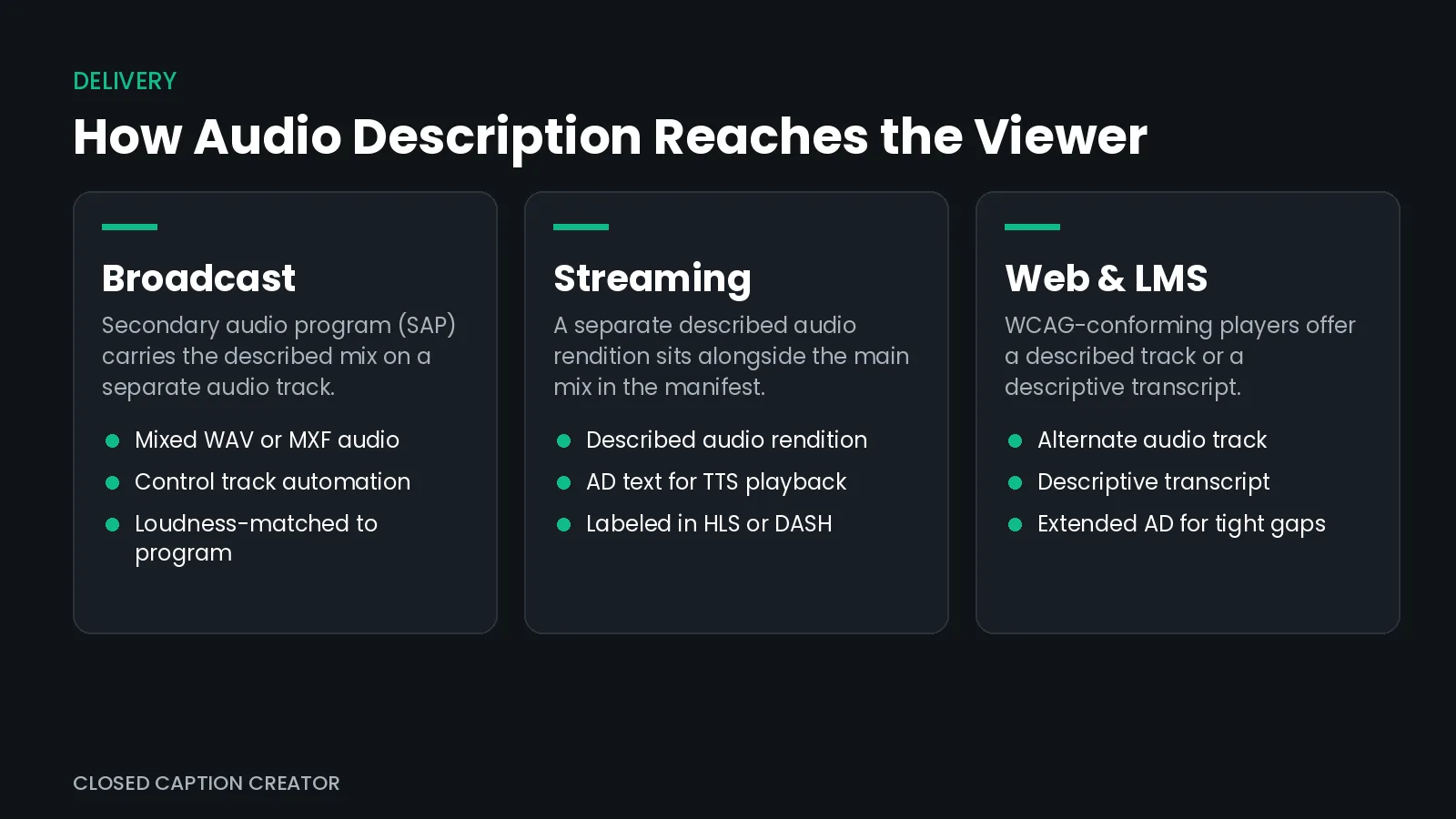
The description script is only the start. How it reaches the viewer depends on the platform.
Broadcast
Description rides on the secondary audio program, usually delivered as a mixed WAV or an extra audio track in the MXF. The mix has to match the loudness of the main program, and the ducking has to be consistent across the whole title.
Most facilities automate the mix with a control track rather than mixing by hand. Our article on audio description with control track shows how that hands off to a playout system.
Streaming
Streaming platforms carry description as a separate audio rendition in the HLS or DASH manifest, labeled so the player can offer it in the audio menu. Some platforms also accept a timed text description file and render it with text-to-speech at playback.
Web and e-learning
For a website or LMS, you need a player that can offer an alternate audio track, or you fall back to a descriptive transcript at Level A. Check the player before you commission the description. A described track no player can select is wasted spend.
Audio Description Compliance Checklist
- Identify your rulebook. FCC, ADA Title II, Section 504, Section 508, or an EU member state regime.
- Confirm your DMA. Broadcasters should check whether their market is already in the phase-in or lands in the January 2027 group.
- Separate exempt from non-exempt hours. Live and near-live content does not count toward the FCC quotas.
- Pick your WCAG level. Level AA means real audio description, not a transcript.
- Confirm the delivery path. Secondary audio for broadcast, a labeled rendition for streaming, a capable player for web.
- Set a voicing standard. Decide between human narration and synthetic voice, and keep it consistent within a series.
- QC the described mix. Check loudness, ducking, and that no description talks over dialogue.
- Keep records. Quarterly hour counts, exemption reasoning, and delivery confirmations are what you will need if a complaint arrives.
How Closed Caption Creator Helps
Closed Caption Creator handles description in the same project as your captions and subtitles, so one timeline drives every accessibility deliverable.
- Description authoring. Write and time description events against the video, with automatic warnings when a description will not fit the available gap.
- Synthetic and human voice. Generate narration with our ElevenLabs integration, or import recorded voice talent.
- Standard and extended AD. Switch between the two without rebuilding the project.
- Broadcast mixes. Export a mixed WAV, a description-only stem, or a control track for automated mixing downstream.
- Descriptive transcripts. Produce a Level A text alternative from the same description events.
See the audio description editor for the full feature set, or compare the market in our roundup of the top 5 audio description editors for broadcast. If your team is starting from zero, our free audio description for beginners course walks through a first project end to end.
Frequently Asked Questions
How many hours of audio description does the FCC require?
Covered stations and MVPD systems must provide 50 hours of audio description per calendar quarter during prime time or children's programming, plus 37.5 additional hours per quarter between 6:00 a.m. and 11:59 p.m. local time. That is 87.5 hours in total.
Is audio description required by the ADA?
Not by name. The ADA reaches audio description through WCAG. The ADA Title II web rule requires WCAG 2.1 Level AA, and success criterion 1.2.5 at that level requires audio description for prerecorded video. A transcript alone is not enough at Level AA.
When is the ADA Title II compliance deadline for video?
April 26, 2027 for public entities serving 50,000 people or more, and April 26, 2028 for smaller entities and special districts. The Department of Justice extended both dates by roughly a year in an interim final rule issued April 20, 2026.
Which TV markets have to provide audio description in 2027?
Nielsen DMAs 121 through 130 join the requirement on January 1, 2027. The FCC adds ten markets each year, ending with DMAs 201 through 210 on January 1, 2035.
Is live programming exempt from audio description?
Yes. Live and near-live programming is exempt under the FCC rules. Near-live means recorded no more than 24 hours before its first transmission, which covers most news, sports, and daily talk programming.
What is the difference between standard and extended audio description?
Standard description fits into the existing gaps in the program audio and does not change the running time. Extended description pauses the video to make room for longer narration, which makes the program longer. Only standard description is usable for broadcast.
Does a transcript count as audio description?
Only at WCAG Level A, under success criterion 1.2.3, where a full text alternative is an accepted substitute. At Level AA, success criterion 1.2.5 requires audio description specifically, and the US federal rules point to Level AA.
Can synthetic voice be used for audio description?
Yes. No US or EU rule requires human narration. Synthetic voice is widely used for high-volume library work and e-learning. Many broadcasters still prefer human narration for flagship scripted titles, where tone carries part of the storytelling.
This article is general information for media professionals, not legal advice. Consult communications counsel for decisions about your specific compliance obligations. Ready to build a description pipeline? Talk to our team or start a free trial.