FCC Closed Captioning Requirements: The 2026 Compliance Guide
What do the FCC closed captioning rules require?
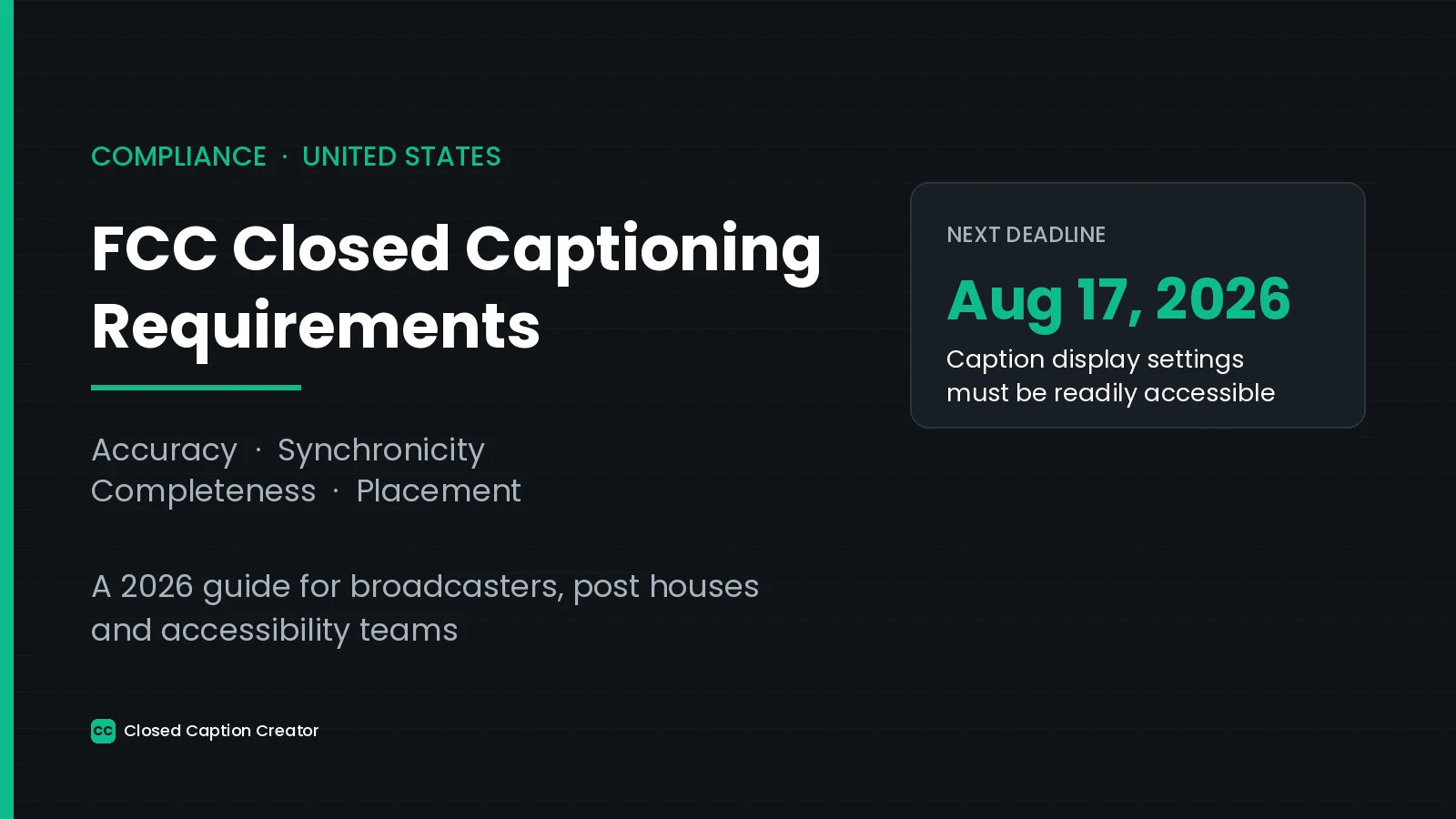
The FCC requires closed captions on nearly all US television programming, and those captions must be accurate, synchronous, complete, and properly placed. Video programmers are responsible for caption quality. Distributors are responsible for delivery and monitoring. A separate rule taking effect August 17, 2026 requires caption display settings to be readily accessible.
What Does the FCC Require for Closed Captions?
The Federal Communications Commission regulates captioning under 47 CFR Part 79. The rules cover two separate things: whether a program has captions at all, and whether those captions are good enough to use.
Almost all new, non-exempt video programming shown on US television must be captioned. That obligation sits with the video programming distributor, which includes broadcasters, cable operators, and satellite providers.
Quality is the part most caption teams get graded on. Since 2014, the FCC has held captions to four defined standards. Miss them badly enough and the program is out of compliance, even though captions were technically present.
If you are new to the terminology, our guide on closed captioning versus subtitles explains why the FCC cares about captions specifically, not subtitles.
What Changes on August 17, 2026?
On August 17, 2026, manufacturers of covered devices and multichannel video programming distributors (MVPDs) must make closed caption display settings readily accessible to viewers who are deaf or hard of hearing.
The FCC adopted this rule in its Closed Captioning Display Settings Report and Order, released July 19, 2024. The rule itself became effective September 16, 2024, but the compliance date was pushed to August 17, 2026 to give manufacturers time to redesign their menus.
The Commission did not dictate a specific menu design. Instead it named four factors it will use to judge whether settings are readily accessible.
| Factor | What the FCC is looking for |
|---|---|
| Proximity | Caption settings sit close to other commonly used controls, not buried several menus deep. |
| Discoverability | A viewer can find the settings without already knowing where they are. |
| Previewability | The viewer can see the effect of a change, such as font size or color, before committing to it. |
| Consistency and persistence | Settings behave the same way across the interface and survive restarts and channel changes. |
Does this affect caption authors? Not directly. The obligation lands on device makers and MVPDs. It matters to caption teams for a practical reason: more viewers will start changing caption size, font, and background. Captions authored with fragile positioning or tight line breaks look worse when a viewer scales them up.
What Are the Four FCC Caption Quality Standards?
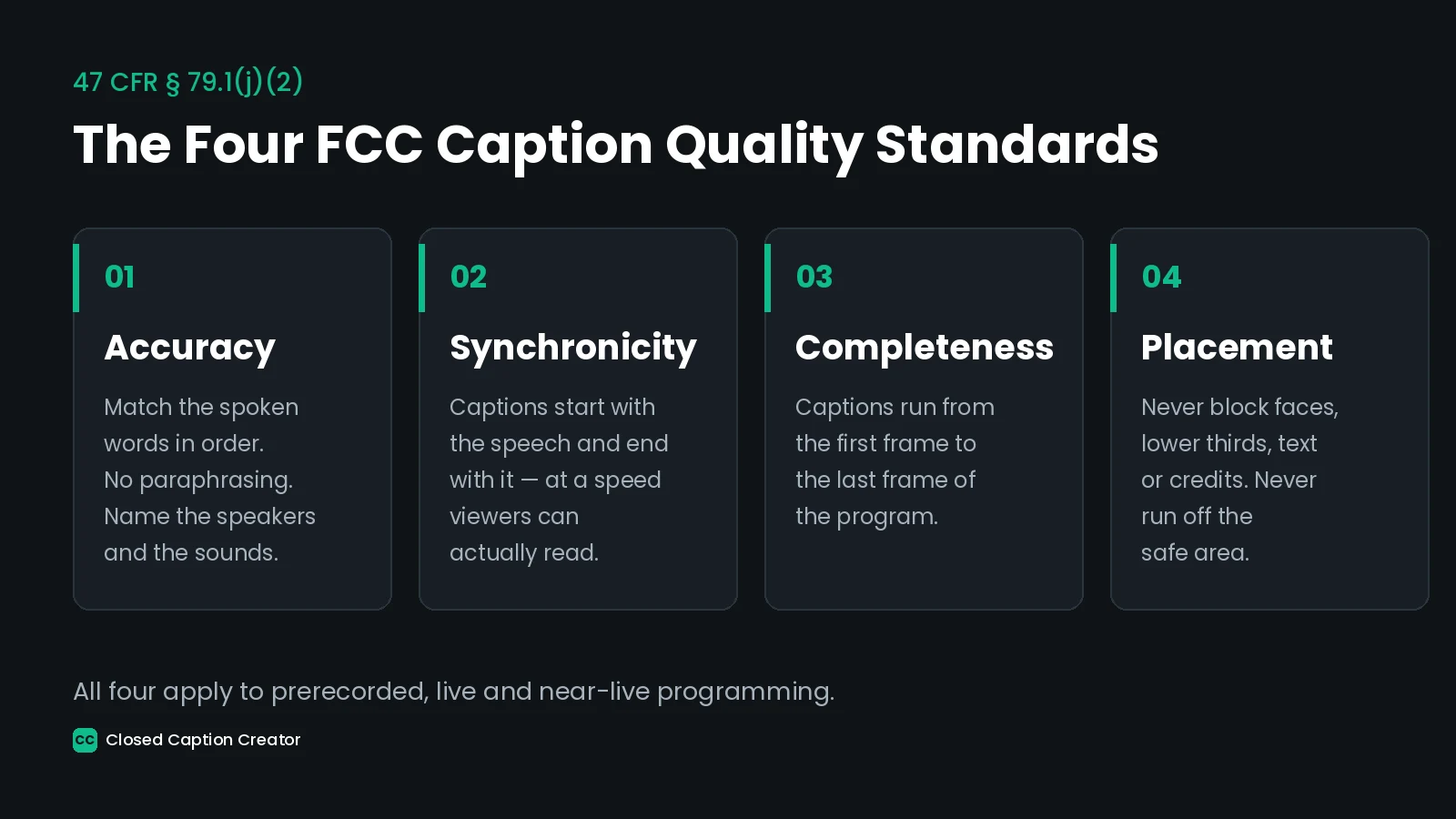
The FCC's caption quality standards are accuracy, synchronicity, completeness, and placement. They are defined in 47 CFR § 79.1(j)(2), and they apply to prerecorded, live, and near-live programming alike.
Accuracy
Captions must match the spoken words in their original language, in the order spoken. No paraphrasing, except where time constraints force it. Proper names and places cannot be substituted.
The rule also asks for correct spelling with the right homophones, correct punctuation and capitalization, correct tense, and accurate numbers. If a character uses slang or bad grammar on purpose, the captions mirror it.
Non-verbal information counts too. Speaker identification, music cues, sound effects, and audience reaction all belong in the captions when the program allows for them.
Synchronicity
Captions must begin when the speech or sound begins and end roughly when it ends. They also have to display at a speed viewers can read.
That second half is where most files fail. A caption that is perfectly timed to the audio but sits on screen for half a second is not compliant. Reading rate is a compliance issue, not a style preference.
Completeness
Captions must run from the beginning of the program to the end. In practice this means checking the first and last frames, the segments around commercial breaks, and any material added after the main edit was locked.
Placement
Captions must not block important visual content — faces, lower thirds, weather graphics, credits, or on-screen text. Lines cannot overlap each other, and captions cannot run off the edge of the screen.
Placement problems get worse on vertical and mobile formats, where the safe area is much tighter. See our guide to captioning for 9x16 video for the safe zone details.
Is 99% Accuracy an FCC Requirement?
No. The FCC deliberately declined to adopt a numerical accuracy threshold. In its 2014 caption quality order, the Commission considered quantitative error rates and chose a descriptive standard instead. There is no 99% rule in Part 79.
What the rules use is a de minimis test. A captioning error is judged in context, and the FCC weighs:
- The type of failure and the reason it happened
- Whether it was a one-time event or a continuing pattern
- How understandable the program remained despite the errors
- How quickly corrective action was taken
For live and near-live programming, the FCC applies these factors case by case and accounts for the delays inherent in real-time captioning.
The 99% figure is still useful — it is a common benchmark in vendor contracts and delivery specs, and it gives QC teams something measurable. Just do not present it to a client as the legal standard. It is a service level, not a regulation.
Who Is Responsible — the Programmer or the Distributor?
Both, for different things. The FCC splits the obligation so that neither side can point at the other when captions fail on air.
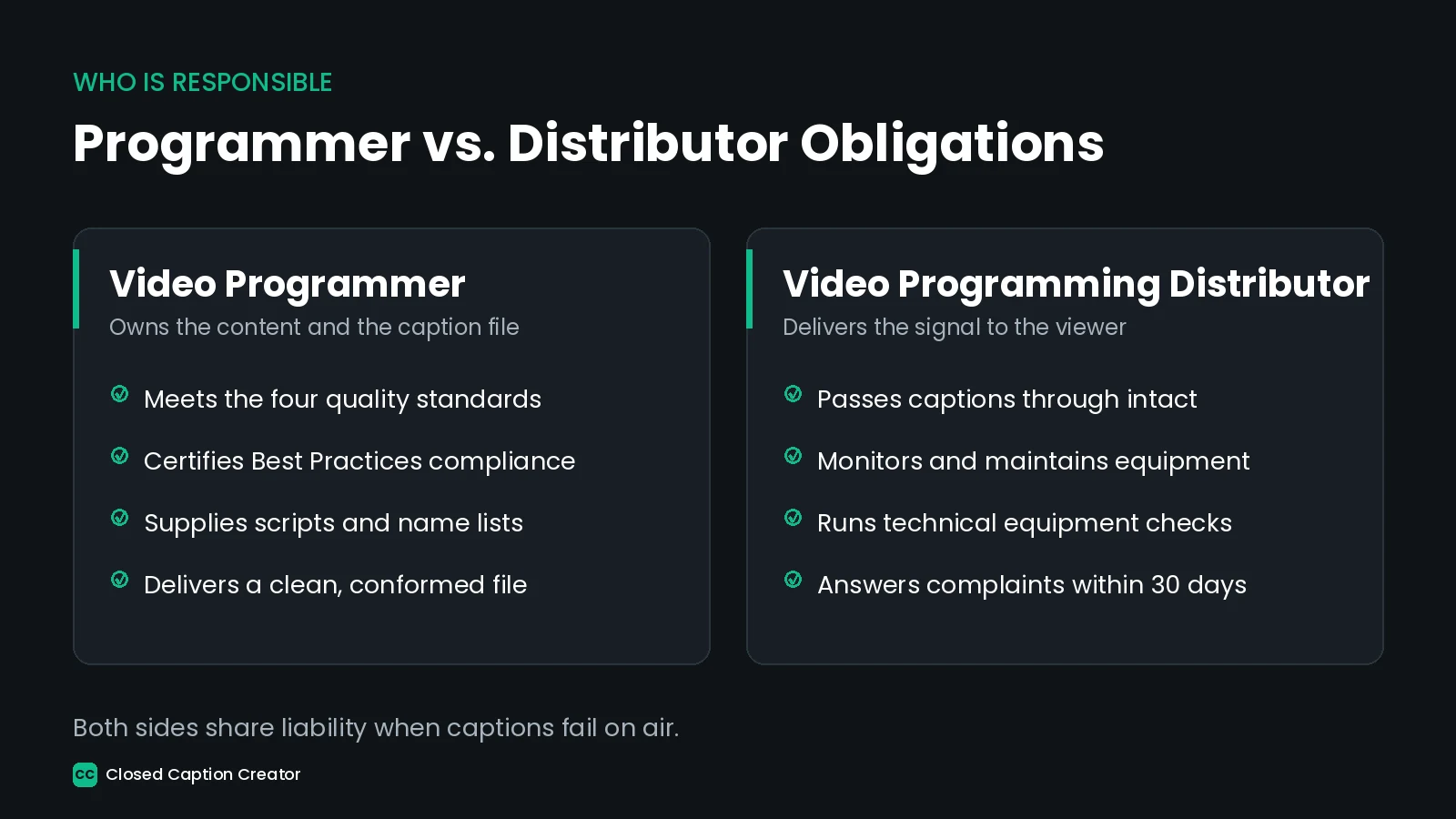
Video programmers own the content and the caption file. They are responsible for meeting the four quality standards, and they certify compliance with the FCC's captioning Best Practices.
Video programming distributors deliver the signal. They must pass captions through intact, monitor and maintain their captioning equipment, run technical equipment checks, and keep records of that work.
The Best Practices provisions in § 79.1(k) also set expectations for the handoff between them. Programmers are asked to give captioning vendors advance access to scripts, proper name lists, and song lyrics, plus a clean, high-quality audio signal. Vendor agreements should include performance requirements, spot-check verification, and captioner training.
If you build or buy tooling for this handoff, our article on build versus buy for subtitle editors walks through the trade-offs.
Which Programming Is Exempt from FCC Captioning Rules?
Section 79.1(d) lists thirteen self-implementing exemptions. Self-implementing means you do not apply for them and the FCC does not certify them — you either qualify or you do not.
| Exemption | Scope |
|---|---|
| Pre-1996 contracts | Contracts in effect on or before February 8, 1996 where captioning would breach the agreement. Renewals do not qualify. |
| Granted waivers | Programming the FCC has found economically burdensome under § 79.1(f). |
| Languages other than English or Spanish | Exempt, except scripted programming that can use the electronic newsroom technique. |
| Primarily textual programming | Program schedule channels, community bulletin boards, and similar text-based services. |
| Late night hours | Programming distributed between 2 a.m. and 6 a.m. local time. |
| Short interstitials and PSAs | Interstitial material, promos, and public service announcements of 10 minutes or less. |
| EBS programming | Video transmitted by an Educational Broadband Service licensee. |
| Local non-news, no repeat value | Locally produced programming of local public interest where the electronic newsroom technique is unavailable. |
| New networks | The first four years after a video programming network begins operation. |
| Primarily non-vocal music | Programming that consists mostly of instrumental music. |
| 2% of gross revenue cap | No provider must spend more than 2% of a channel's prior-year gross revenue on captioning. |
| Channels under $3 million | Channels with annual gross revenues under $3,000,000 in the prior calendar year. Already-captioned programming must still pass through. |
| Local K-12 educational programming | Instructional programming produced locally by public television stations for schools. |
Two cautions. First, an exemption from Part 79 is not an exemption from everything — the ADA, Section 508, and state accessibility laws may still apply. Second, the revenue exemptions apply per channel or stream, so a small channel inside a large group can qualify on its own.
Do FCC Rules Apply to Online and Streaming Video?
Yes, for some of it. Under § 79.4, video programming that aired on US television with captions must also be captioned when it is later delivered over the internet. This comes from the Twenty-First Century Communications and Video Accessibility Act (CVAA).
The quality standards travel with the content. If a program was captioned to FCC standards for broadcast, the streaming version is expected to carry captions of at least that quality — not a rough auto-generated pass.
Content made only for the web has never aired on US television, so § 79.4 does not reach it. That does not make it unregulated. The ADA, Section 508 for federal and federally funded content, and state law all bite. Outside the US, the European Accessibility Act now applies to a wide range of digital services — see our breakdown of EAA compliance requirements for video.
How Do FCC Caption Complaints Work?
Viewers can file a captioning complaint with either the FCC or the video programming distributor. The complaint must be filed within 60 days of the problem.
Once the FCC forwards a complaint, the distributor has 30 days to respond in writing to both the Commission and the complainant. If the FCC notifies a distributor of a pattern or trend of complaints, the distributor must conduct spot checks of caption quality within 30 days and address the underlying issue.
The practical lesson for caption teams: keep evidence. Retain the delivered caption file, the QC report, and the delivery timestamp for every program. When a complaint arrives months later, that archive is the difference between a quick written response and an expensive investigation.
An FCC Compliance Checklist for Caption Teams
Run this pass before every broadcast delivery. It maps directly to the four quality standards.
- Confirm the frame rate and drop-frame setting. A 29.97 non-drop file delivered against a drop-frame spec drifts by about 3.6 seconds per hour. That is a synchronicity failure.
- Verify both EIA-608 and CEA-708 services. Check that the 608 stream is present and correct, not just the 708 payload. Our guide on embedding 608 and 708 captions covers the encode step.
- Check reading rate. Flag any caption below your minimum duration or above your characters-per-second ceiling. Set the limit once in your project metrics and let the software enforce it.
- Do a placement pass. Scrub the lower thirds, credits, and any burned-in graphics. Move captions up where they collide.
- Confirm completeness. Verify captions start on the first spoken word and continue past the final segment, including anything added after picture lock.
- Check speaker IDs and sound effects. Multi-speaker scenes and off-screen dialogue are the usual gaps.
- Keep preparation materials. Scripts, name lists, and lyrics reduce errors and demonstrate Best Practices compliance.
- Archive the proof. Store the final file, the QC report, and the delivery record together.
For a deeper walkthrough, read how to QC closed captioning and subtitles and our QC best practices for broadcast.
How Closed Caption Creator Supports FCC Compliance
Closed Caption Creator was built for broadcast delivery, so the FCC standards map onto features rather than manual checks.
- Reading rate and metrics. Set characters per second, words per minute, minimum duration, and line limits per project. The editor flags every caption that breaks the rule as you work.
- QC and review. Run automated checks for overlaps, gaps, duration, and character limits before delivery, then share a review link with the client. See QC and review.
- Placement control. Position captions on a grid, with safe area guides, so lower thirds and credits stay readable.
- 608 and 708 export. Export SCC, MCC, and MXF-ready caption data with the frame rate and drop-frame setting locked to your spec. See format support.
- Frame rate conform. Convert between frame rates without drift when a delivery spec changes late.
New to the workflow? Start with our complete guide on how to closed caption video, or browse the training videos.
Frequently Asked Questions
What are the FCC's four caption quality standards?
Accuracy, synchronicity, completeness, and placement. Captions must match the spoken words, appear in time with the audio at a readable speed, run the full length of the program, and avoid blocking important on-screen content.
Does the FCC require 99% caption accuracy?
No. The FCC chose not to adopt a numerical accuracy threshold. It judges errors using a de minimis test that weighs the type of failure, whether it is ongoing, how understandable the program remained, and how fast it was fixed. 99% is an industry benchmark, not a regulation.
What happens on August 17, 2026?
Manufacturers of covered devices and MVPDs must make caption display settings readily accessible. The FCC will assess this using four factors: proximity, discoverability, previewability, and consistency and persistence. Caption authors are not directly covered by this rule.
Is my channel exempt from FCC captioning rules?
Possibly. Section 79.1(d) exempts thirteen categories, including channels with under $3 million in prior-year gross revenue, programming between 2 a.m. and 6 a.m., and networks in their first four years. Exemptions are self-implementing and are not certified by the FCC.
Do FCC captioning rules apply to streaming video?
They apply to programming that already aired on US television with captions and is later delivered over the internet, under § 79.4. Web-only content falls outside that rule but may still be covered by the ADA, Section 508, or state accessibility law.
How long do I have to respond to a caption complaint?
Viewers have 60 days from the problem to file. Once the FCC forwards the complaint, the video programming distributor has 30 days to respond in writing to both the Commission and the complainant.
Are FCC rules the same as ADA captioning requirements?
No. FCC rules under Part 79 govern television and certain IP-delivered programming. The ADA covers places of public accommodation and applies more broadly to workplaces, education, and public-facing digital content. Many organizations have to satisfy both.
This article is general information for media professionals, not legal advice. Consult communications counsel for decisions about your specific compliance obligations. Ready to tighten up your caption QC? Talk to our team or start a free trial.