Solution Use Case
Descriptive Video Transcript (DVT)
Create descriptive video transcripts and
audio descriptions all in one application.
Trusted by global teams








What is a descriptive video transcript (DVT)?
A descriptive video transcript is a text file that combines a video's dialogue with descriptions of its visual content. DVTs can be converted into screen-reader friendly HTML and published alongside a video, giving people who are Deaf or have difficulty seeing visual information an equivalent viewing experience.
Make your videos accessible online
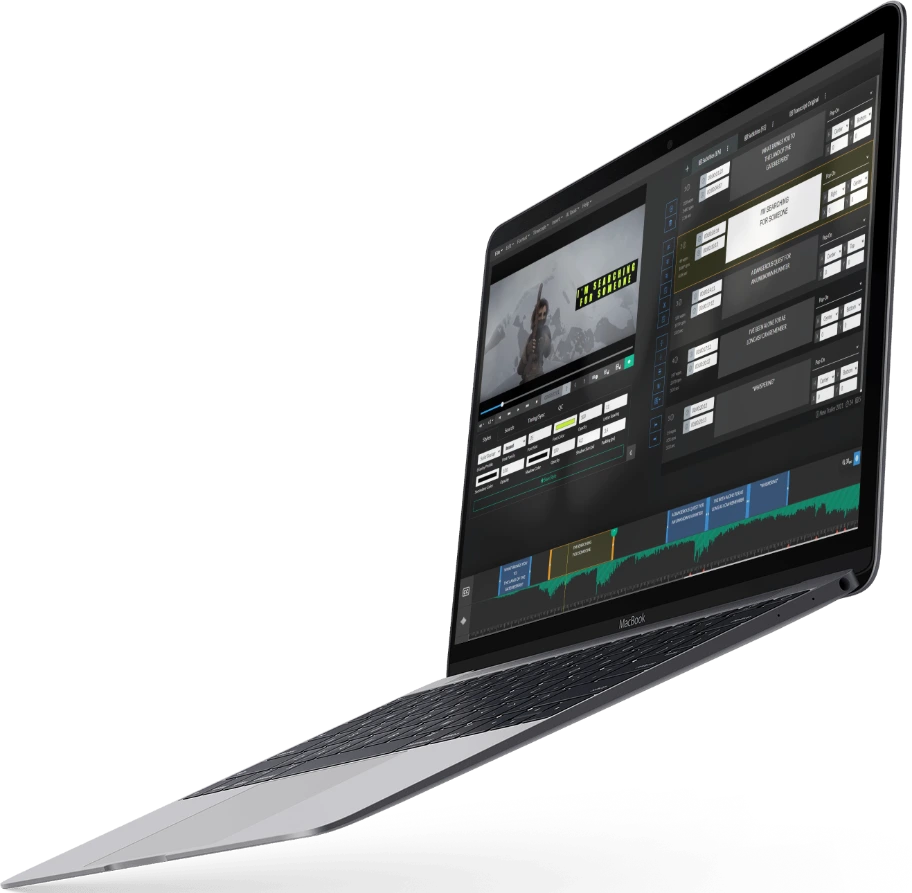
Easily create descriptive video transcripts by merging audio descriptions and subtitle events in Closed Caption Creator.
Descriptive video transcripts (DVTs) are text files that contain both the dialogue and video descriptions. DVTs can be converted into screen-reader friendly HTML and added to a website along with the accompanying video. This provides an alternative viewing experience for users who may be Deaf or have difficulty seeing the visual information. Screen-readers should be able to read a DVT and provide the same information as watching the video.
Closed Caption Creator makes it easy to create and edit DVT files by allowing users to merge subtitle and audio description events into a single document. Timestamps, text, and formatting can be edited based on the user's requirements.
DVT files can be exported in multiple formats, including plaintext files, Microsoft Word documents (.docx), and CSV.
- Merge audio descriptions (AD) and subtitles
- Edit timestamps, formatting, and text
- View the DVT alongside the video
- Available for both web and desktop
- Export Microsoft Word (.docx), Excel (.csv), and Plaintext (.txt) files
DVT or the Audio Description Plugin — which do I need?
Both workflows start from the same audio description events in your project. Choose a text transcript for web accessibility, or finished audio for broadcast delivery.
| Audio Description Plugin | Descriptive Video Transcript (DVT) | |
|---|---|---|
| Final output | Broadcast-ready audio files (WAV, MP3, FLAC) | Text transcript (TXT, DOCX, CSV) or screen-reader friendly HTML |
| Voice | 100+ synthetic voices, or record your own | No audio — the reader uses their own screen reader |
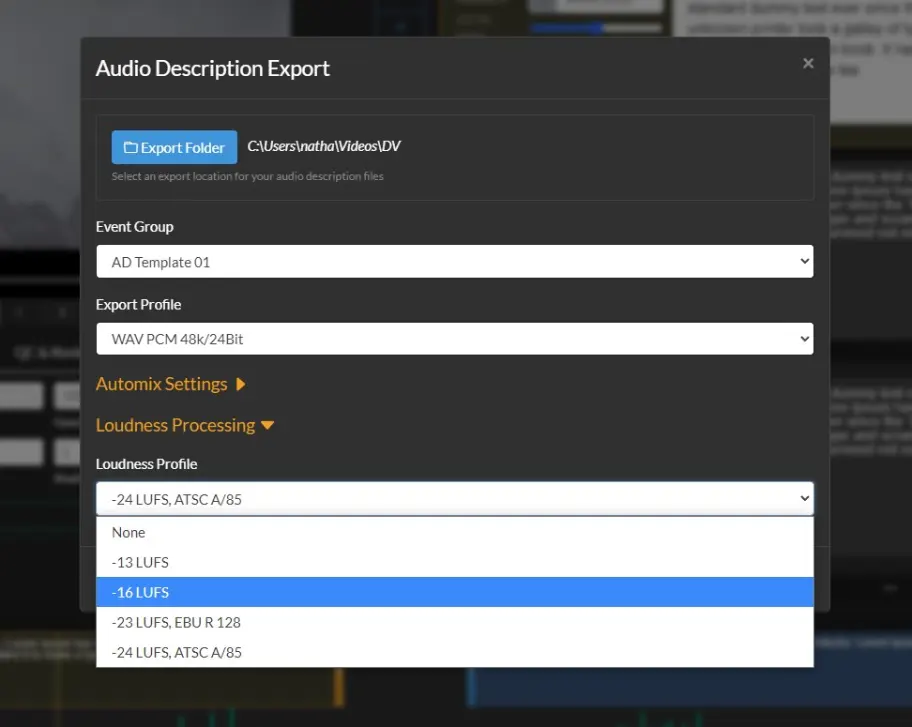
| Mixing and loudness | AutoMix with loudness normalization (ATSC A/85, EBU R 128) | Not applicable |
| Best for | Broadcast and streaming audio description delivery | Web publishing, review, and translation handoff |
Multi-Track Timeline
See subtitles and descriptions on separate tracks
Build your DVT visually, with every event exactly where it belongs.
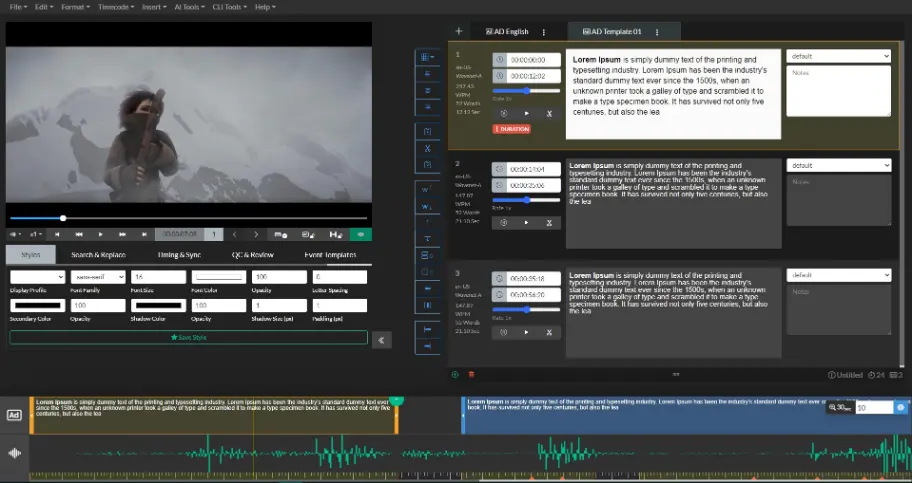
Audio descriptions and subtitles appear on separate timeline tracks, making it easy to edit and adjust your DVT layout. Once merged, events order themselves chronologically by start and end time, so descriptions stay matched to the right dialogue.
- Separate timeline tracks for AD and subtitles
- Chronological merge based on event start and end times
- Edit timestamps, text, and formatting after merging
- View the finished DVT alongside the video
Audio Descriptions & Subtitles
Create audio descriptions and subtitles all in one application
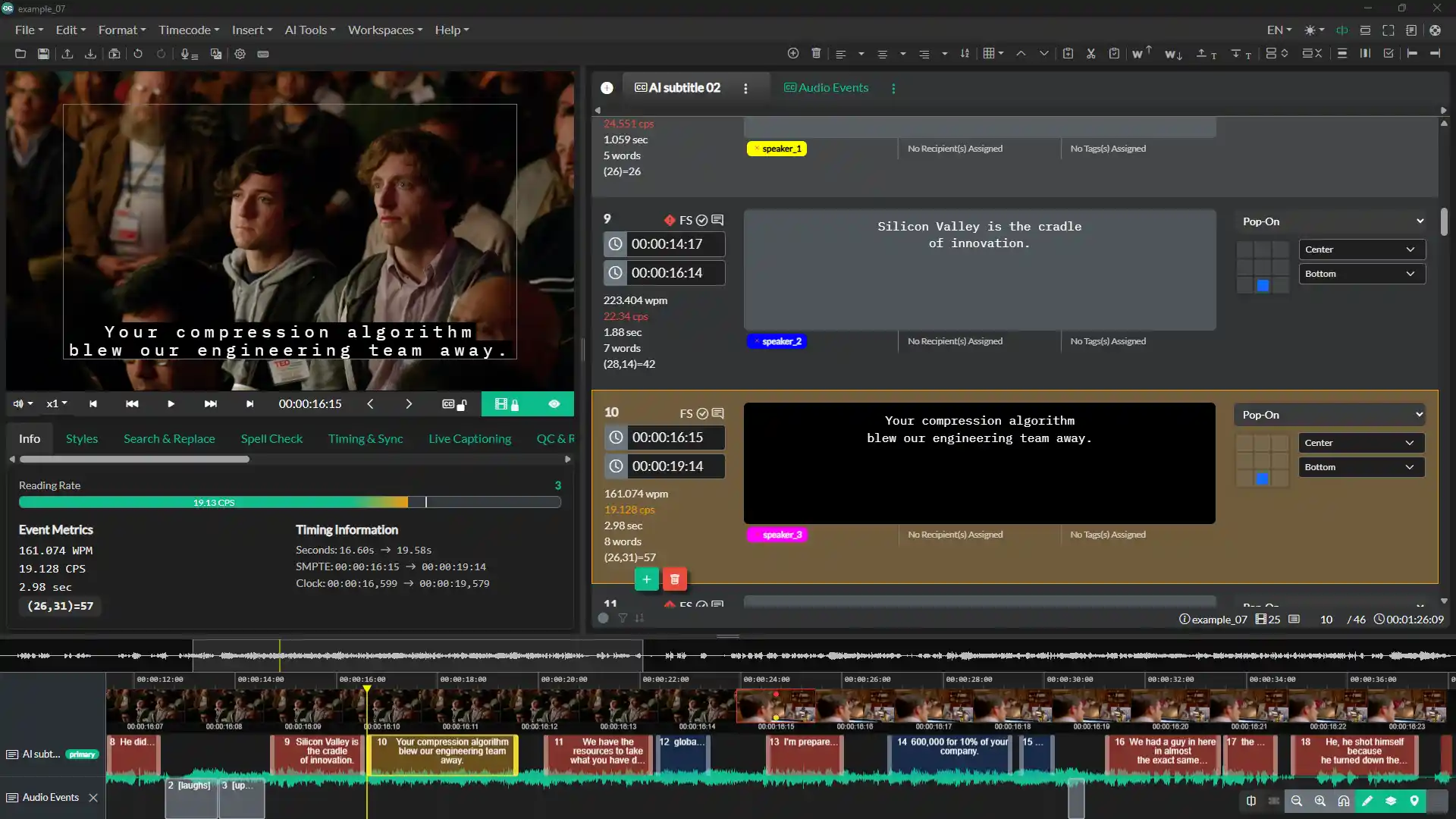
Closed Caption Creator is the only application that allows users to create subtitles and audio descriptions in the same project.
This allows users to unlock new workflows, like the ability to easily create descriptive transcripts from existing subtitles and audio descriptions.
Broadcast and media teams can benefit by using one application for closed captioning, and audio descriptions.
No more switching between different programs to create closed captioning, subtitles, and AD. Do it all with Closed Caption Creator.
DVT Creation
Merge audio description and subtitle events to create DV transcripts
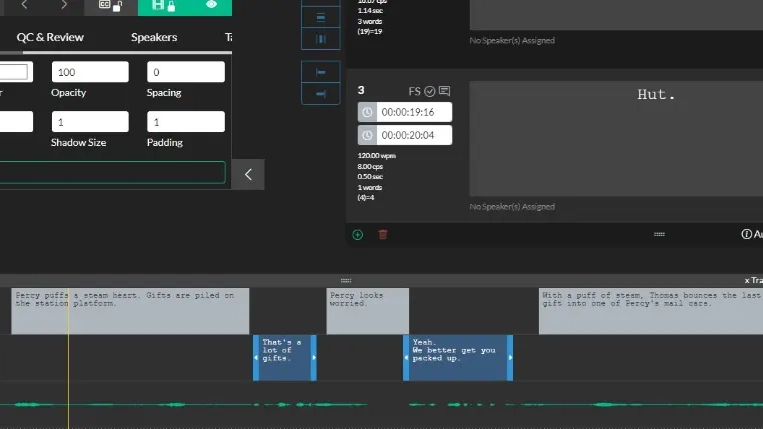
View audio descriptions, and subtitles on separate timeline tracks in order to easily edit and adjust your DVT layout.
Once subtitles and audio descriptions are merged, they will order themselves based on their start and end times. This ensures the final DVT is ordered chronologically and descriptions are properly matched to dialogue.
Users can make further edits as required.
Export & Delivery
Export descriptive transcripts in multiple formats
Closed Caption Creator supports over 30 different closed caption formats, and 5 transcript formats including Microsoft Word (.docx), Excel (.csv), and plaintext (.txt).
DV transcripts are usually delivered in a custom format depending on the client. We are happy to provide alternative format options upon request.
How It Works
From project to published DVT
Four steps to a screen-reader friendly transcript your audience can use anywhere.
STEP 1
Author
Create subtitles and audio descriptions in the same project — no switching between programs.
STEP 2
Merge
Combine AD and subtitle events into one document, ordered chronologically by start and end time.
STEP 3
Edit
Fine-tune timestamps, text, and formatting while viewing the DVT alongside the video.
STEP 4
Export
Deliver as .docx, .csv, or plaintext — or convert to screen-reader friendly HTML for the web.
- 5Transcript export formats supported
- 30+Caption and subtitle formats in the same application
- 1 projectSubtitles and audio descriptions authored together
Ready to get started?
Sign up for a free 7-day trial of Closed Caption Creator and receive access to our video tutorials and courses.
Create closed captioning, subtitles, transcripts, and audio descriptions all in one application. Closed Caption Creator is made for broadcast and captioning teams who are committed to delivering high-quality, accessible video. Sign up now, or contact us for a live demo.
Descriptive video transcript questions
Answers about creating, editing, and exporting descriptive video transcripts in Closed Caption Creator.
Closed Caption Creator can merge audio description and subtitle events into a single document. After merging, events order themselves chronologically based on their start and end times, so descriptions stay matched to the correct dialogue. Timestamps, text, and formatting can then be edited as required.
Descriptive video transcripts can be exported as Microsoft Word (.docx), Excel (.csv), and plaintext (.txt) files, with five transcript formats supported in total. DV transcripts are often delivered in custom formats depending on the client, so alternative format options are available upon request.
Yes. Closed Caption Creator is the only application that lets users create subtitles and audio descriptions in the same project. Both event types appear on separate timeline tracks, making it possible to produce a descriptive transcript directly from existing subtitle and audio description work.
A DVT provides an alternative viewing experience for users who are Deaf or have difficulty seeing visual information. Because the transcript contains both dialogue and video descriptions, a screen reader can read the DVT and convey the same information as watching the video.
Yes. DVT creation is available in both the web and desktop versions of Closed Caption Creator. The transcript can be viewed alongside the video while editing, and timestamps, text, and formatting remain fully editable to match client requirements. New users can start with a free 7-day trial.
A standard transcript contains only dialogue, while a descriptive video transcript also includes descriptions of the visual content. Because Closed Caption Creator supports both subtitles and audio descriptions in one project, a DVT can be built by merging those two event types rather than writing descriptions from scratch.